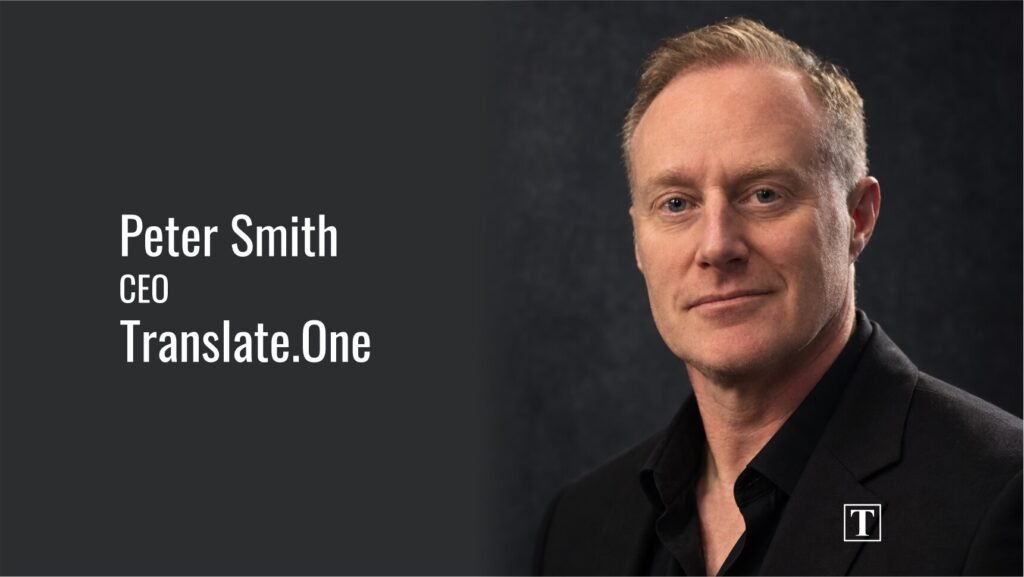
In an industry being reshaped by artificial intelligence almost by the month, Peter Smith has spent more than two decades betting on a different instinct: that technology and human expertise grow stronger together, not apart. As Chief Executive Officer of Translate.One, a global language services and technology company headquartered in Atlanta, he has built that conviction into a strategy of rapid, deliberate growth, completing seven acquisitions in the past four years alone, most recently Landoor and Vertaalbureau Perfect, alongside sustained investment in the company’s own Magna platform.
Today Translate.One operates across 20 countries and four continents, serving organizations in life sciences, manufacturing, technology, eLearning and more. Speaking with The Tycoon Magazine, Peter spoke about the decisions that shaped his path to CEO, how he decides which companies belong under the Translate.One umbrella, and where he believes the language services industry is heading next.
1. Take us back to the start of your career in language services. With more than 25 years in the translation industry now behind you, which early decisions or turning points set you on the path to becoming CEO of Translate.One?
When I started in the language services industry more than 25 years ago, technology was not nearly as embedded in the way we worked as it is today. I became interested very early in how technology could make language processes faster, more efficient and more scalable.
That interest became an important foundation for my career. I began to see that language services were not just about translating words from one language into another. They involve people, technology, processes, data and increasingly sophisticated ways of managing global content.
As the industry evolved, translation management systems, machine translation, automation and now AI transformed what language companies could deliver. I have always wanted to be on the side of that evolution rather than waiting for the industry to change around us.
That mindset has influenced many of the decisions we have made at Translate.One. I see technology as an enabler rather than a replacement for the expertise that makes language services valuable.
My journey to becoming CEO was therefore not about one defining decision, but a series of experiences that reinforced the importance of adaptability, technology and having the right people around you.
2. For readers meeting Translate.One for the first time, how would you describe what the company does today, who you serve, and what’s occupying most of your attention as CEO right now?
Translate.One is a global language services and technology company providing translation, localization and interpreting services at scale. We combine human expertise with technology and AI to help organizations communicate across languages, markets and cultures. We have people and operations across 20 countries and four continents, giving us the ability to support customers locally while delivering global consistency.
We serve organizations across industries including life sciences, manufacturing, technology and eLearning. As their multilingual needs become more complex, customers increasingly need more than individual translation projects. They need efficient ways to manage content, workflows, quality and communication across markets.
Our Magna platform is central to this evolution, bringing together AI powered language capabilities, translation and interpreting workflows, language assets, reporting and human quality processes in one technology environment. It enables us to deliver language services more efficiently while giving customers greater control and visibility over their multilingual operations.
As CEO, I spend most of my time on strategy, acquisitions and integration. Our goal is not only to become larger, but to build a more capable global organization by bringing together complementary expertise, technology and people, and creating the infrastructure and culture to make that combination work.
3. Translate.One has made seven acquisitions in the past three years, most recently Landoor and Vertaalbureau Perfect. What’s the thinking behind growing the company this way, and how do you decide which businesses are the right fit to bring into the fold?
Our acquisition strategy is driven by a clear objective: to build a genuinely global organization that can provide customers with the right language, technology and specialist capabilities wherever they operate.
Language services are inherently local. Customers want global consistency, but they also need people who understand their markets, languages, industries and regulatory environments. Acquisitions allow us to combine that local expertise with the resources and infrastructure of Translate.One.
We are not simply looking for companies that add revenue. We look for businesses that bring something meaningful to the wider organization: specialist expertise, strong customer relationships, technology, geographic reach or new capabilities.
Just as importantly, we look for people. Their knowledge, relationships and entrepreneurial spirit can be as valuable as the business itself. The goal is not just to become bigger, it is to become more capable while preserving what made each business successful.
4. AI and machine translation keep improving, and the debate over what that means for human translators isn’t going away. Where do you see AI genuinely changing how language services get delivered, and where do you think the market is still overestimating what it can do?
AI is going to fundamentally change how language services are delivered, but I don’t believe it eliminates the need for human expertise. I see the future as a combination of AI, automation and human intelligence.
For certain types of content, AI translation has already reached a level where fully automated workflows can be appropriate. Generic communications, high volume informational content and lower risk material can often be processed efficiently without human translation at every stage.
The situation changes when content becomes more complex or critical. In life sciences, for example, terminology, regulatory requirements and the consequences of an error can be significant. AI may need to operate alongside specialized terminology, language models, brand guidance, testing, review and quality assurance.
The bigger question, then, is not whether AI can translate, but how organizations manage their entire multilingual content environment. Translation is only one part of that process; content, language assets, workflows, security, distribution and quality also need to be managed.
5. Language services has no shortage of players right now, from traditional agencies to AI native platforms. What genuinely sets Translate.One apart from the competition, and how does that show up in the actual work?
What sets Translate.One apart is the combination of our Magna Language Technology Platform and the global expertise of our organization.
Magna brings together the key capabilities needed to manage global communication in one environment, including translation, interpreting, workflows, resource management, billing and reporting, quality management and AI powered language services. This gives customers a more connected way to manage their language requirements rather than relying on multiple disconnected systems and providers.
At the same time, our centralized Centers of Excellence give companies across the group access to specialist expertise in areas such as technology, procurement, training and operational support. This allows us to combine the knowledge and local strengths of our individual businesses with the resources of a global organization.
For customers, that means we can offer both local expertise and global capabilities, supported by technology and shared resources, a combination that is difficult to replicate with either a traditional language provider or a technology only platform.
6. Walk us through one specific decision or moment at Translate.One, good or hard, that still stands out to you, and what it taught you about running the company.
It is difficult to identify one single moment because every acquisition has brought a different lesson. But one of the most consistent has been the importance of culture.
When we acquire a company, we are not simply acquiring customers, technology or financial performance. We are bringing people into a new organization, and they are a significant part of what made the business attractive to us in the first place.
I have learned that successful integration is not about standardizing everything immediately. It is about understanding what worked, preserving the strengths of the acquired business, and then finding ways to create synergies with the wider organization. For me, that means listening, respecting what each company has built, and making the combined organization stronger without losing what made the individual businesses successful.
7. Bringing multiple companies together, each with its own team and culture, is never simple. How do you approach leadership and culture building at Translate.One, particularly when integrating new teams after an acquisition?
The way I think about this is that some things need to be shared across the organization, and some things need to stay close to the market.
Our Centers of Excellence exist so that every business in the group has access to the same expertise in areas like technology, procurement and training, rather than each company having to build that on its own. That gives us consistency, and it means an acquired business does not lose time reinventing something that already exists elsewhere in Translate.One. Our training platform is a good example. Employees across different countries and businesses now have access to the same core training and development, a small thing operationally but an important one for building a shared sense of identity.
Leadership itself needs to stay close to where the work happens. I am based in the United States, but many of our operational leaders are in Europe, near our operating centers, because decisions about how work gets delivered should be made by people who understand that market, not from a distance.
The hardest part is finding the right balance between the two. Give too little central support and teams waste time and resources. Push too much standardization too quickly and you risk losing what made the business worth acquiring in the first place. I do not think there is a fixed formula for that balance. It is something we work out business by business, and it is one of the things I spend the most time thinking about.
8. Where do you see the language services industry five years from now, and how is Translate.One positioning itself to lead that shift rather than follow it?
The move toward AI is not going to stop, so being able to embrace AI and build it into key functions of the business will be increasingly important. Technology more broadly will also continue to play a central role.
For Translate.One, this means continuing to invest in our internal technology and development capabilities, including Magna, to ensure our technology delivers real value for customers and keeps pace with a rapidly changing industry.
At the same time, I don’t see a future where people become less important to global communication. AI will change how language professionals work, but human expertise, judgment and cultural understanding will remain essential. That makes investing in our people equally important, ensuring they have the training, technology and support they need to work effectively in an AI enabled industry.
9. What’s one piece of advice you’d give to someone building a company or a career in a fast changing industry today?
Embrace change and never assume the way your industry works today is the way it will work tomorrow. Technology has transformed the language industry throughout my career, and AI will bring even more change. The key is to understand how these changes affect your customers and be willing to adapt.
I would also emphasize the importance of relationships. Invest in people, keep learning and build capabilities that will serve you over the long term. You cannot predict every change, but you can build the ability to respond to it.
10. Is there anything else about your journey, Translate.One, or your outlook that we haven’t asked about but that you’d like readers to know?
Our story goes beyond growth through acquisitions or AI. It is about building an organization that can support the increasingly complex way businesses communicate globally.
We are bringing together people, expertise and technology to make global communication easier, faster and more scalable. Magna is an important part of that evolution, but human expertise remains at the center of what we do. Our ambition is to keep evolving with our customers and the industry while building a strong organization for the future.
